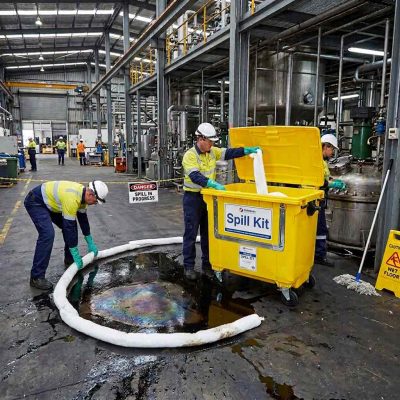
A spill kit is only useful if it can deal with the liquid that’s actually spilled. Put an oil-only kit next to a battery acid store, or a small vehicle kit next to a row of 205 litre drums, and you’ll find out the hard way that “a spill kit” isn’t one product.
This guide explains the main types of spill kit, how to choose the right size, where to keep them and what to do with used absorbents, so you can match your spill kits to the risks on your site.
The short answer
- Oil, diesel, petrol or lubricants, especially outdoors or near water: an oil-only spill kit.
- Acids, alkalis, solvents or unknown chemicals: a chemical spill kit.
- Everyday spills of oils, coolants and water-based fluids indoors: a general purpose (maintenance) spill kit.
- AdBlue at fuelling points and depots: an AdBlue spill kit.
Then size the kit so it can absorb at least the largest spill you could realistically have in that area.
The four main types of spill kit
Oil-only spill kits
Oil-only absorbents soak up hydrocarbons such as engine oil, diesel, petrol, hydraulic oil and lubricants, but repel water. That makes them the right choice outdoors, in the rain, on wet yard surfaces and on water, because the absorbents fill up with oil rather than rainwater. In the UK, oil-only absorbents are usually white.
Typical uses: fuel and oil storage areas, yards, plant and machinery, transport depots, marinas and construction sites.
Chemical spill kits
Chemical absorbents are made to handle aggressive liquids such as acids, alkalis and solvents, as well as most oils and water-based fluids. Chemical absorbents are usually yellow, so they’re easy to tell apart in an emergency.
Typical uses: laboratories, chemical stores, battery charging areas, cleaning chemical stores, and anywhere the spill could be something other than oil. Always check the safety data sheet for the substances you store, and wear the PPE it specifies before dealing with a spill.
General purpose (maintenance) spill kits
General purpose, or maintenance, absorbents soak up oils, coolants, cutting fluids, water-based liquids and mild chemicals. They’re usually grey. They’re ideal for indoor areas such as workshops, factory floors and warehouses, where most spills are everyday fluids rather than aggressive chemicals.
Because they absorb water as well as oil, they aren’t the best choice for outdoor oil spills in wet conditions. Use an oil-only kit there.
AdBlue spill kits
AdBlue is a water-based urea solution, so oil-only absorbents won’t pick it up. AdBlue spill kits use absorbents designed for it. They’re worth keeping at AdBlue dispensers, IBC and bulk tank storage, and in fleet and agricultural workshops.
| Kit type | Absorbs | Doesn’t suit | Usual colour |
|---|---|---|---|
| Oil-only | Oils, fuels, lubricants (repels water) | Water-based liquids, chemicals | White |
| Chemical | Acids, alkalis, solvents, plus oils and water-based fluids | Only limited by the chemical’s own hazards (check the SDS) | Yellow |
| General purpose / maintenance | Oils, coolants, water-based fluids, mild chemicals | Aggressive chemicals, outdoor oil spills in the wet | Grey |
| AdBlue | AdBlue (urea solution) | Oils and chemicals | Kit specific |
If you’re not sure what might spill, a chemical kit is the safest all-round choice, because it can handle oils and water-based liquids as well.
What size spill kit do I need?
Spill kits are sized in litres. The figure is roughly how much liquid the absorbents in the kit can soak up, so a 50 litre kit can absorb about 50 litres. To choose a size:
- Find the largest container in the area. A realistic worst case is one container failing completely. If that’s a 205 litre drum, a 50 litre kit won’t be enough on its own.
- Think about how spills happen there. Filling and decanting usually cause small, frequent spills. A dropped drum or a punctured IBC causes a big one.
- Allow for the time it takes to get more help. On a remote site, or out on the road, you need enough to deal with the spill yourself.
| Where | Typical kit | Example |
|---|---|---|
| Vehicles, vans and small workspaces | 15 to 50 litre bag kit | 15 litre maintenance kit, 50 litre oil-only kit |
| Workshops and small drum stores | 50 to 120 litre kit | 120 litre chemical kit (wheeled bin) |
| Drum stores, fuel points and loading bays | 240 to 360 litre wheeled bin kit | 240 litre oil-only kit |
| IBC stores, tank farms and large sites | 600 to 1,000 litre kits, or several smaller kits | See our oil spill kits and chemical spill kits |
Spill kits deal with spills that escape. They don’t replace secondary containment. Drums and IBCs of oil or chemicals should also sit on a drum spill pallet or IBC bund. See our guide: What size bund do I need for an IBC?
What’s inside a spill kit?
Most kits contain a mix of:
- Absorbent pads to soak up the spill and wipe surfaces clean.
- Absorbent socks to surround the spill and stop it spreading.
- Disposal bags and ties for the used absorbents.
- Instructions, so anyone can use the kit quickly.
Larger kits may add pillows, booms or granules. Many sites also keep drain covers with their spill kits. Surface water drains usually run straight to a river or stream, so covering a nearby drain is often the first thing to do.
For example, our 50 litre oil-only kit contains 50 pads, four 1.2 m socks, 5 hazardous waste bags and ties, and an instruction sheet. You can also top up kits with loose absorbent pads and rolls and socks, pillows and booms.
Bag, bin or spill station?
- Clip-closed bags and holdalls are light and portable, ideal for vehicle cabs, vans and small areas.
- Wheeled bins hold more, are weather resistant and can be moved by one person to where they’re needed.
- Spill stations are fully stocked, wall or floor-mounted stations that keep a large kit visible and organised at a fixed point, such as a fuel store or loading bay.
Where should spill kits be kept?
Keep spill kits close to where spills are most likely: fuel and oil stores, drum and IBC storage, filling and dispensing points, loading bays and workshops. The kit should be easy to reach but protected from damage and misuse. Ideally keep a second kit somewhere else, in case the first can’t be reached safely during an incident.
Vehicles carrying oils, fuels or chemicals should carry a kit suited to their load, along with the right PPE. Vehicles carrying dangerous goods under ADR also have specific equipment requirements, so check these with your dangerous goods safety adviser.
Is a spill kit a legal requirement?
There isn’t one law that says “every site must have a spill kit”. However, causing or allowing pollution can be a criminal offence, and businesses have a duty to prevent it. Environmental regulators expect sites storing oil or chemicals to have suitable spill equipment and trained staff, and spill kits are often required by environmental permits, insurers and customer audits.
The GPP 22 guidance on dealing with spills (for Scotland, Wales and Northern Ireland) recommends keeping spill kits near likely spill points, training staff to use them, and having drain covers ready. In England, the Environment Agency’s guidance is on GOV.UK.
If a spill reaches a drain, river, stream or the ground, report it straight away:
- England, Scotland and Northern Ireland: the 24-hour pollution hotline on 0800 80 70 60.
- Wales: Natural Resources Wales on 0300 065 3000 (press 1).
Using a spill kit: the basics
- Stay safe. Check what has spilled and put on the right PPE. If it’s dangerous or too big, keep people away and call for help.
- Stop the source if it’s safe to do so, for example by standing a leaking drum upright.
- Protect drains with a drain cover or socks.
- Contain the spill by surrounding it with socks.
- Absorb it with pads, working from the outside in.
- Bag the used absorbents and label the bags.
- Restock the kit straight away, and report the spill if needed.
For more on drum spills, see how to contain a drum spill.
Disposing of used absorbents
Absorbents soaked in oil or chemicals are normally hazardous waste (special waste in Scotland). Keep them separate from general waste, use a registered waste carrier, and keep the right paperwork. Never wash spilled liquid or contaminated material into a drain.
Keeping your spill kits ready
- Check kits regularly, and after every use. Security tags show at a glance whether a kit has been opened.
- Replace used contents straight away with a refill kit. Refills are available for most of our bin and holdall kits.
- Train staff so they know where kits are and how to use them.
- Review your kits whenever you start storing something new.
Frequently asked questions
What spill kit do I need for diesel?
An oil-only spill kit. Its absorbents pick up diesel but repel water, so they keep working outdoors and in the rain. Indoors, a general purpose kit will also absorb diesel.
What’s the difference between an oil-only and a general purpose spill kit?
Oil-only absorbents only take up oils and fuels and repel water. General purpose (maintenance) absorbents take up oils and water-based liquids. Use oil-only outdoors and on water, and general purpose indoors.
Can I use a chemical spill kit on oil?
Yes. Chemical absorbents also absorb oils and water-based liquids, so a chemical kit is a good choice where the spill could be any of these. On wet ground outdoors, though, an oil-only kit is better for oil because it won’t fill up with rainwater.
What size spill kit should I keep in a van?
Most vans carry a 15 to 50 litre bag kit, matched to the load. If you carry drums or larger containers, size the kit to the biggest likely spill, and check any ADR requirements for dangerous goods.
Can spill kits be refilled?
Yes. Wheeled bins, static bins and vinyl holdalls are reusable, and refill kits are available. Clip-closed bag kits are usually single use.
This guide is a general summary to help you choose suitable spill kits. It isn’t legal advice. Always follow the safety data sheets for the substances you store, and check the current guidance from the Environment Agency, Natural Resources Wales, SEPA or NIEA. Need help choosing the right kits for your site? Contact our team.


